Treatment Progress
Why Topical Acne Medication Requires Weeks, Not Days, of Observation
Between the desire for quick improvement and the time it takes for the skin to react, we distinguish between changes that can be waited out and symptoms that require immediate adjustment.
Click on unfamiliar terms to see their meanings immediately.
If you constantly change medications based on a day or two of stinging or new breakouts, it is difficult to distinguish between irritation and changes in the original acne. Follow the recommended usage and record new breakouts and irritation separately in weekly intervals.
| What to record | How to check | When to seek prompt adjustment |
|---|---|---|
| New acne breakouts | Record the number of comedones, red acne, and deep-seated acne once a week under the same lighting | Rapid increase in deep, painful nodules and scarring |
| Dryness and stinging | Record the amount and frequency of application along with the use of moisturizers | Severe swelling, blisters, oozing, or pain that interferes with daily life |
| Duration of use | Distinguish between the prescribed plan and the actual days missed | Pregnancy plans, new medications, or possibility of serious side effects |
| Product change | Change one product at a time and record the start date | Sudden widespread worsening after layering multiple products |
Looking in the mirror every day can make small changes feel larger
Acne treatment may require 6 to 8 weeks of the same therapy before improvement is visible. Rather than relying on daily impressions, compare weekly photos taken under the same lighting and angle, as well as the number of new acne breakouts; if the prescribed duration differs, prioritize that plan.
If you experience stinging or dryness, the amount and frequency of use must be readjusted
Some treatments, such as retinoids, can cause dryness and stinging, but this does not mean you must unconditionally endure severe irritation. Record the amount and frequency of application, as well as your moisturizing and cleansing habits, to adjust them with your prescribing medical provider.
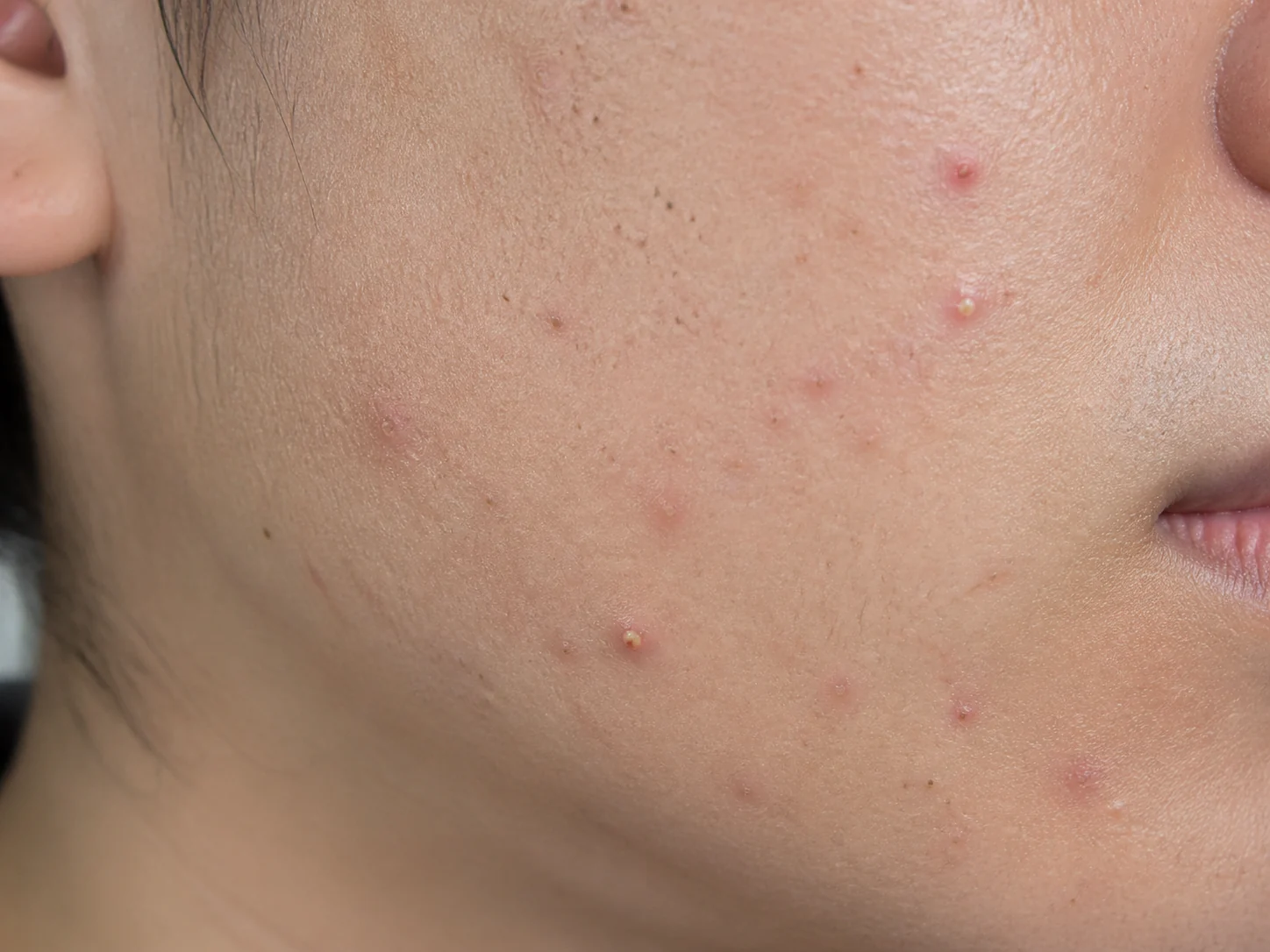
Since comedones, papules, and pustules can appear together on one face, we examine the deepest acne and the rate at which new ones form together.
The more frequently you add new products, the harder it becomes to identify the problem
scrubbingLayering exfoliants and acne-fighting ingredients all at once can mix inflammation with irritation. If your skin suddenly breaks out, organize the products you recently started and how you actually used them before adding stronger products.
Try organizing your information this way before your appointment
In 7-day photos taken under the same lighting, separate new comedonespapulepustules, and nodules from remaining redness, brown spots, and scarring; this makes it easier to determine the treatment sequence. When comparing with guides on acneClosed comedonesand inflammatory acne, refer to these records as well.
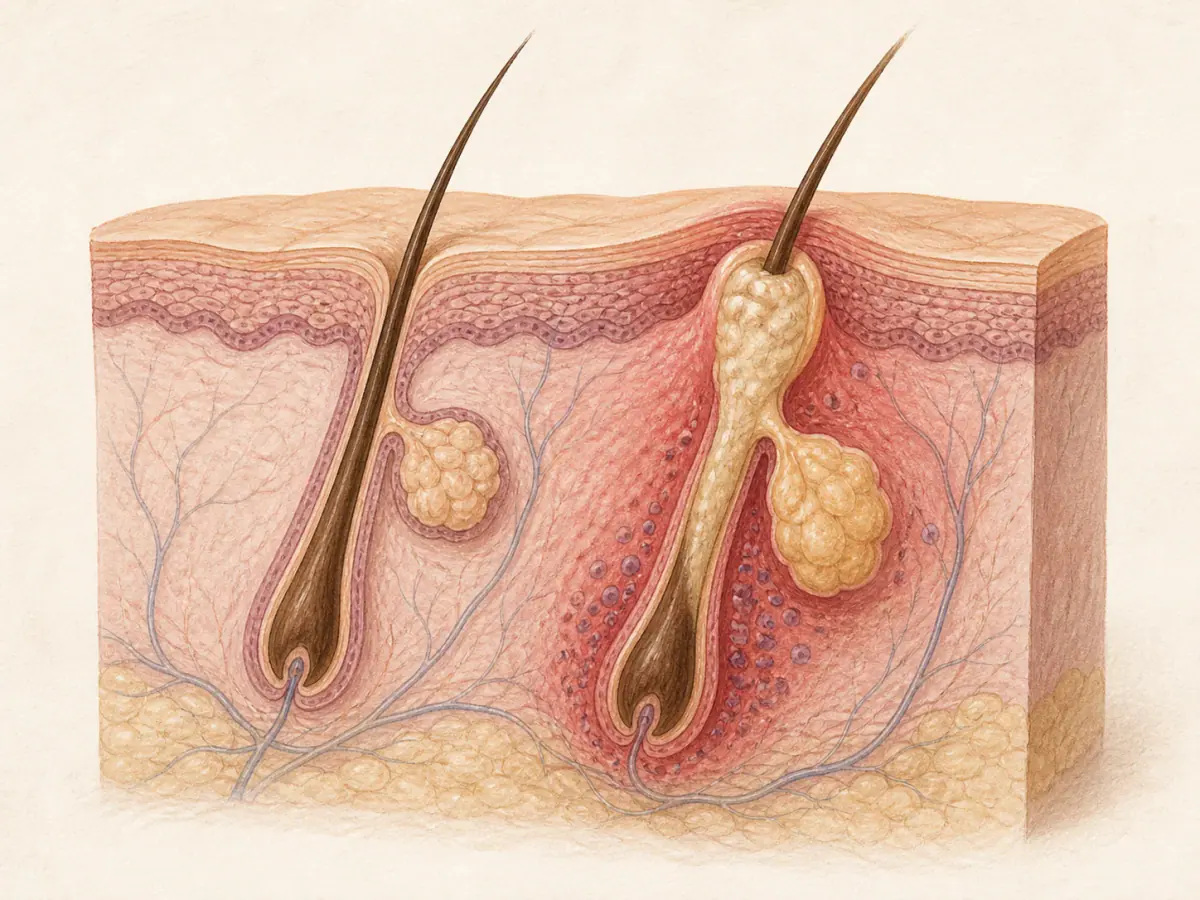
As sebum and dead skin cells accumulate at the entrance of the hair follicle and inflammation deepens, the appearance of the acne and the risk of scarring may change.
Treatment response is evaluated by looking at the trend of new acne breakouts over several weeks and the level of tolerable irritation, rather than the redness of a single day.
View based on my situation
The next steps will vary depending on your current appearance
Rather than picking just one similar part from a photo, look at the depth of the acne, remaining marks, and accompanying discomforts such as itching or stinging.
When it closely resembles acne
Acne begins with follicular keratinization, where dead skin cells at the opening of the hair follicle Sebumclump together and block it, and within that, the bacteria naturally living on the skin acne bacteriaThis is the process involved in this inflammation. Hormonal changes such as puberty or pregnancy, family history, and certain medications can increase the risk of occurrence, and skin or hair products that block pores may also be related to acne. Diet or stress can be aggravating factors for some people, but a single food or cleansing habit cannot be concluded as the sole cause of all acne.
the speed at which new inflammation develops and the same area's Recurrence The first goal is to reduce the intervals. While reducing the medication, the prescription is adjusted to ensure that skin condition and sleep, digestion, and menstrual rhythms are not significantly disrupted.When it is closer to closed comedonal acne (whiteheads)
The focus of treating closed comedonal acne is topical medication to reduce pore clogging from closed and open comedones, combined with low-irritation skin care. topical retinoids, Benzoyl PeroxideOptions such as azelaic acid are selected based on skin condition and the possibility of pregnancy; since results usually take several weeks, record the initial irritation and the number of new acne breakouts. Do not squeeze them by hand or repeatedly use antibiotics alone.
Reduce the speed at which new comedones form and the rate at which they progress to red inflammation, and avoid excessive Extraction·stabilize the skin texture without exfoliation.When it is closer to inflammatory acne (cystic/pustular)
Inflammatory acne occurs through a complex process where excessive sebum is produced and dead skin cells poreblock the pores, leading to deep inflammation. Cystic acne, which feels like large, painful lumps under the skin, or deep noduleslesions are prone to leaving scars, so it is better to determine the treatment direction early. Hormonal changes during puberty or around menstruation, certain medications, and repeated friction may overlap to worsen the condition, but it cannot be attributed to a single food item or a failure to wash.
Lower the rate at which new deep nodules and pustules form, and reduce the duration that redness, pain, and marks persist after inflammation.Please record only this much before your appointment
- The ratio of comedones, papules, pustules, and nodules, and the number of new acne breakouts per week
- Facial heat, sebum, dryness, and digestion, bowel movements, and sleep
- Menstrual cycle, oral and topical medications, the period of improvement, and the timing of recurrence
- Those who experience recurring comedones and inflammation on the face, chest, or back despite thorough cleansing
- Those whose acne worsens before or after hormonal changes such as menstruation or pregnancy
- Those who feel acne has increased after using new cosmetics, hair products, or prescription medications
Frequently Asked Questions
Common questions after reading this guide
What is the primary cause of acne?
It is a process where sebum and skin cells block the pores, and bacteria and inflammation are added. Risk contexts such as hormones, family history, medications, and products overlap differently for each person.
Will acne disappear if I stop eating chocolate or drinking milk?
While the link between certain diets and worsening symptoms is being researched, a single specific food is not the cause for everyone. Record reactions that recur for you, but it is difficult to view one single food as the sole cause.
Does stress cause new acne?
Stress can worsen acne for some people, but it is not established as the sole cause. Hormones, sleep, and changes in products are also considered.
If I think it was caused by medication, can I stop taking it immediately?
Do not stop taking medication arbitrarily. Show the prescriber the name of the medication, the start or change date, and photos of the acne to discuss the correlation and safe alternatives.
Evidence and Update Information
This content was organized by Korean medicine doctor Choi Yeon-seung based on the materials below and was updated on 2026-08-26.